Emotional regulation — the ability to understand, express, and manage emotions — is one of the most important life skills a child can develop in the early years. Yet it’s also one of the most challenging. Toddlers and preschoolers experience big feelings with small tools, and they rely heavily on the adults around them to help navigate frustration, sadness, excitement, and even joy. This process, known as co-regulation, is the foundation for emotional resilience later in life.
High-quality preschool programs like Grow and Learn Preschool play a crucial role in teaching children how to identify emotions, communicate their needs, and practice healthy coping skills. When families choose a preschool, they’re not just choosing a place where their child learns numbers and letters—they’re choosing an environment where emotional intelligence is built day by day. In fact, research increasingly shows that early emotional development has a greater long-term impact on academic success and well-being than early academic instruction alone.
Below is a look at how high-quality preschool programs help young children develop emotional regulation and resilience through intentional teaching, routines, relationships, and play.
Understanding Emotional Development in the Early Years
Between ages 2 and 5, a child’s brain develops rapidly in areas responsible for emotional control, empathy, and problem-solving. However, this development is not automatic. Children need repeated experiences where adults model calm behavior, label emotions, and guide them through challenges.
Many parents worry about tantrums, hitting, whining, or tears—but these behaviors are normal. They’re not signs of misbehavior; they’re signs of an immature regulation system still “under construction.” When preschools understand this, they respond with patience and guidance rather than punishment.
The Power of Co-Regulation
One of the most important ways preschool supports emotional growth is through co-regulation—the responsive, comforting presence of a caregiver who helps a child settle down, feel safe, and understand their emotions.
Teachers do this by:
- Using calm tones and gentle posture
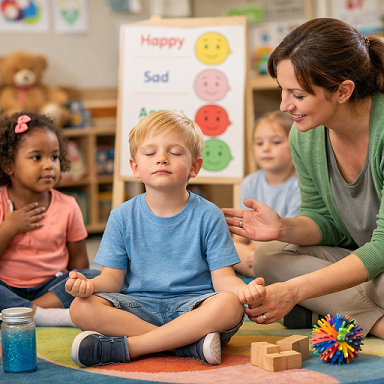
- Helping children name emotions (“It looks like you’re feeling frustrated because the block tower fell”)
- Modeling breathing strategies
- Offering reassurance and connection
- Giving children time to recover before talking through a problem
Over time, children begin to internalize these strategies, learning how to soothe themselves without relying entirely on adults.
The Role of Predictable Routines
Predictable routines are essential for emotional stability. Young children feel more secure when they know what’s happening next—especially during transitions, which are common triggers for big emotions.
High-quality preschools use:
- Consistent daily schedules
- Visual timers or picture schedules
- Gentle transition cues (songs, countdowns, turning lights low)
When children understand the flow of their day, they’re less overwhelmed and more capable of managing their emotions.
Teaching Emotional Vocabulary
Children cannot regulate emotions they cannot identify. That’s why preschool classrooms intentionally teach emotional vocabulary through:
- Feelings charts
- Storybooks about emotions
- Puppet play with scenarios like sharing or problem-solving
- Songs that label feelings
- Guided discussions during circle time
Over time, children shift from expressing distress through behavior (“I’m mad so I hit”) to expressing it through words (“I don’t like that,” or “I need help”). This change is a major milestone in emotional maturity.
Social Interaction and Conflict Resolution
Preschool is often the first environment where children must navigate group dynamics. Learning to take turns, share materials, and resolve disagreements builds resilience and self-control.
Teachers guide children through conflicts using strategies such as:
- Prompting children to explain their perspective
- Helping them listen to others
- Offering simple choices to rebuild cooperation
- Teaching problem-solving phrases (“Can I have a turn when you’re done?”)
- Allowing natural consequences when appropriate
These interactions teach children that challenges can be worked through effectively—a key foundation of resilience.
Play as Emotional Growth
Play is not just fun; it is one of the most powerful tools for emotional development. Through play, children experiment with emotions, practice handling frustration, and build confidence.
Different types of play support emotional development in different ways:
- Dramatic play lets children act out feelings and scenarios.
- Art and sensory play calm the nervous system and offer expressive outlets.
- Cooperative games teach teamwork, patience, and losing gracefully.
- Outdoor play reduces stress and boosts mood.
Children who are regularly engaged in play develop stronger emotional awareness and improved coping skills.
Creating a Supportive Classroom Climate
High-quality preschools intentionally cultivate warm, nurturing environments where children feel safe to express themselves. This includes:
- Teachers who greet each child by name
- Classroom spaces designed for comfort—cozy corners, soft lighting, quiet areas
- Clear expectations paired with compassion
- Positive reinforcement
- Modeling kindness, empathy, and patience
When children trust their environment, they’re better able to take emotional risks, try new strategies, and learn from mistakes.
Partnership with Families
Emotional regulation is more successful when preschools and families work together. Teachers often share classroom strategies with parents, such as:
- Naming emotions at home
- Creating simple calm-down routines
- Using consistent language (“gentle hands,” “take a deep breath”)
- Reading books about feelings
- Establishing predictable home routines
When children receive the same messaging across environments, skills develop more quickly and consistently.
Why Emotional Regulation Matters for Life
Children who develop strong emotional regulation and resilience in preschool are more likely to:
- Adjust easily to kindergarten
- Have positive relationships
- Solve problems independently
- Show empathy
- Handle stress more effectively
- Show stronger academic performance
- Develop long-term confidence and well-being
These aren’t just preschool skills—they’re life skills.