Toddler Developmental Milestones: Ages 2-5
Is My Child on Track?
Wondering what your 2-, 3-, 4-, or 5-year-old should be able to do? Explore age-by-age milestones for language, thinking, social-emotional development, and physical skills—and learn how you can support your child's growth at home.
Every child develops at their own pace. Milestones are general guidelines, not a test your child needs to pass. If you have concerns about your child's development, talk with your pediatrician.
20%
Approximately 20%
more affordable
than comparable local programs*
Toddler Developmental Milestones: Ages 2-5
Is My Child on Track?
Wondering what your 2-, 3-, 4-, or 5-year-old should be able to do? Explore age-by-age milestones for language, thinking, social-emotional development, and physical skills—and learn how you can support your child’s growth at home.
Every child develops at their own pace. Milestones are general guidelines, not a test your child needs to pass. If you have concerns about your child's development, talk with your pediatrician.
Developmental Milestones at a Glance
| Age | Language | Social & Emotional | Thinking & Learning | Physical |
|---|---|---|---|---|
|
2 |
Growing vocubalory & simple phrases |
Parallel play & growing independence |
Simple problem-solving & pretend play |
Running, climbing & improving coordination |
|
3 |
Longer sentences & conversations |
Cooperative play begins |
Puzzles, sorting & simple concepts |
Running, jumping & increasing coordination |
|
4 |
Tells stories & communicates clearly |
Friendships & group play |
Counting, shapes & problem-solving |
Hopping, catching & improving fine motor skills |
|
5 |
More detailed conversations |
Follows group rules & manages emotions |
Early literacy, math & school-readiness skills |
Greater coordination & independence |
Why Developmental Milestones Matter
Developmental milestones are the skills most children master by a certain age. They help parents and pediatricians track growth in physical abilities, language, thinking skills, and emotional development. While every child’s pace is unique, knowing these benchmarks helps spot possible delays early—when interventions are most effective.
Developmental milestones are the skills most children master by a certain age. They help parents and pediatricians track growth in physical abilities, language, thinking skills, and emotional development. While every child’s pace is unique, knowing these benchmarks helps spot possible delays early—when interventions are most effective.
Toddler & Preschool Milestones by Age
Age 2 (24–36 Months): Building Independence
Physical & Motor Skills
- Walks and runs steadily
- Climbs onto furniture without help
- Kicks and throws a ball
- Turns knobs and opens containers
Language & Communication
- Uses 50+ words; combines two-word phrases (“more juice”)
- Points to named objects
- Follows two-step instructions
Cognitive Skills
- Pretend play emerges
- Understands “mine” vs. “yours”
- Sorts shapes and colors
Social & Emotional
- Shows independence but may cling to parents
- Engages in parallel play (playing near others but not directly with them)
Age 3: Social Awareness Grows
Physical & Motor Skills
- Climbs confidently
- Pedals a tricycle
- Dresses with minimal help
Language & Communication
- Speaks in 4–5 word sentences
- Knows name and age
- Understands “in,” “on,” and “under”
Cognitive Skills
- Works toys with levers and buttons
- Understands simple time concepts
- Completes easy puzzles
Social & Emotional
- Starts cooperative play
- Expresses a range of emotions
- Learning turn-taking
Age 4: Mastering New Skills
Physical & Motor Skills
- Hops on one foot
- Catches a bounced ball
- Uses scissors with supervision
Language & Communication
- Tells short stories in full sentences
- Uses plurals and past tense correctly
- Understands “same” and “different”
Cognitive Skills
- Names colors and shapes
- Draws people with 2–4 parts
- Counts small sets of objects
Social & Emotional
- Enjoys group play
- May have a “best friend”
- Separates easily from parents
Age 5: Ready for School
Physical & Motor Skills
- Skips, jumps, and balances for 10+ seconds
- Uses utensils well
- Dresses independently
Language & Communication
- Speaks clearly in complete sentences
- Tells detailed stories
- Uses future tense correctly
Cognitive Skills
- Counts to 10 or higher
- Copies shapes like triangles and squares
- Understands morning, afternoon, evening
Social & Emotional
- Plays games with rules
- Knows real vs. pretend
- Seeks approval from friends
What Does "Kindergarten Ready" Really Mean
Kindergarten readiness is about much more than knowing letters and numbers. Children also need to be able to:
- Follow multi-step directions
- Communicate their needs
- Participate in a group
- Manage everyday routines independently
- Take turns and interact with peers
- Hold pencils and use classroom materials
- Listen to stories and participate in conversations
- Recognize early letters, sounds, numbers, and patterns
- Transition between activities
At Grow & Learn Preschool, our curriculum is intentionally adapted to each age group so children build these skills progressively from the toddler years through Pre-K.
When Should I Talk With My Child's Pediatrician?
Children develop at different rates, so one missed milestone doesn’t necessarily mean something is wrong. However, it’s worth discussing your concerns with your child’s pediatrician if you notice:
- Your child consistently struggles with age-appropriate communication
- Your child has difficulty with movement or coordination
- Your child rarely responds to or engages with others
- Your child has significant difficulty following simple directions
- Your child loses a skill they previously had
One important rule: Don't wait if you're concerned.
If you have concerns about your child’s development, your pediatrician can help determine whether further evaluation or support would be useful.
This is safer and more credible than presenting specific milestone cutoffs as diagnoses.
5 SImple Ways To Support Your Child's Development
Read everyday
Ask questions about the story and let your child describe what they see.
Encourage creative play
Drawing, building, music, pretend play, and crafts support multiple areas of development.
Talk—and listen
Have conversations throughout the day rather than relying only on questions.
Let them solve problems
Give your child time to try things independently before stepping in.
Practice social-emotional skills
Help your child name emotions, take turns, handle frustration, and communicate their needs.
How Preschool Can Support Development
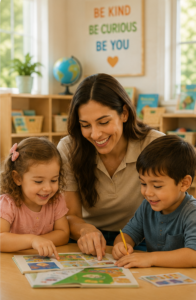
A quality preschool environment gives children daily opportunities to practice the skills they’re developing at home—through structured activities, hands-on learning, social interaction, movement, and age-appropriate challenges.
At Grow & Learn Preschool in Queen Creek, our classrooms are organized by developmental stage, so activities are adapted to the skills children are ready to practice.
Our programs serve children from 1 through 5 years old, with particularly small classrooms for our youngest children.
Frequently Asked Questions About Developmental Milestones
No. Development varies from child to child. Milestones provide general expectations rather than a strict schedule.
Children around age 2 are generally developing rapidly in language, movement, pretend play, problem-solving, and independence. Specific skills vary considerably.
Look for continued progress in communication, movement, social interaction, pretend play, and independence.
At age 4, children typically continue developing language, early literacy and math concepts, social skills, motor coordination, and independence.
Practice listening, following directions, communication, self-help routines, early literacy and math, fine motor skills, and interacting appropriately in a group.
If you’re concerned about your child’s development, talk with their pediatrician. It’s appropriate to ask questions even if you’re simply unsure whether your child’s progress is typical.
Want to See How Children Learn at Grow and Learn Preschool
From toddlers taking their first steps toward independence to Pre-K students getting ready for kindergarten, our classrooms are designed around the developmental needs of each age group.
Come see our classrooms, meet our teachers, and learn how we help children build confidence, independence, and kindergarten-readiness skills.
