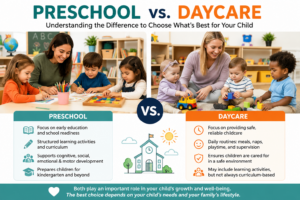
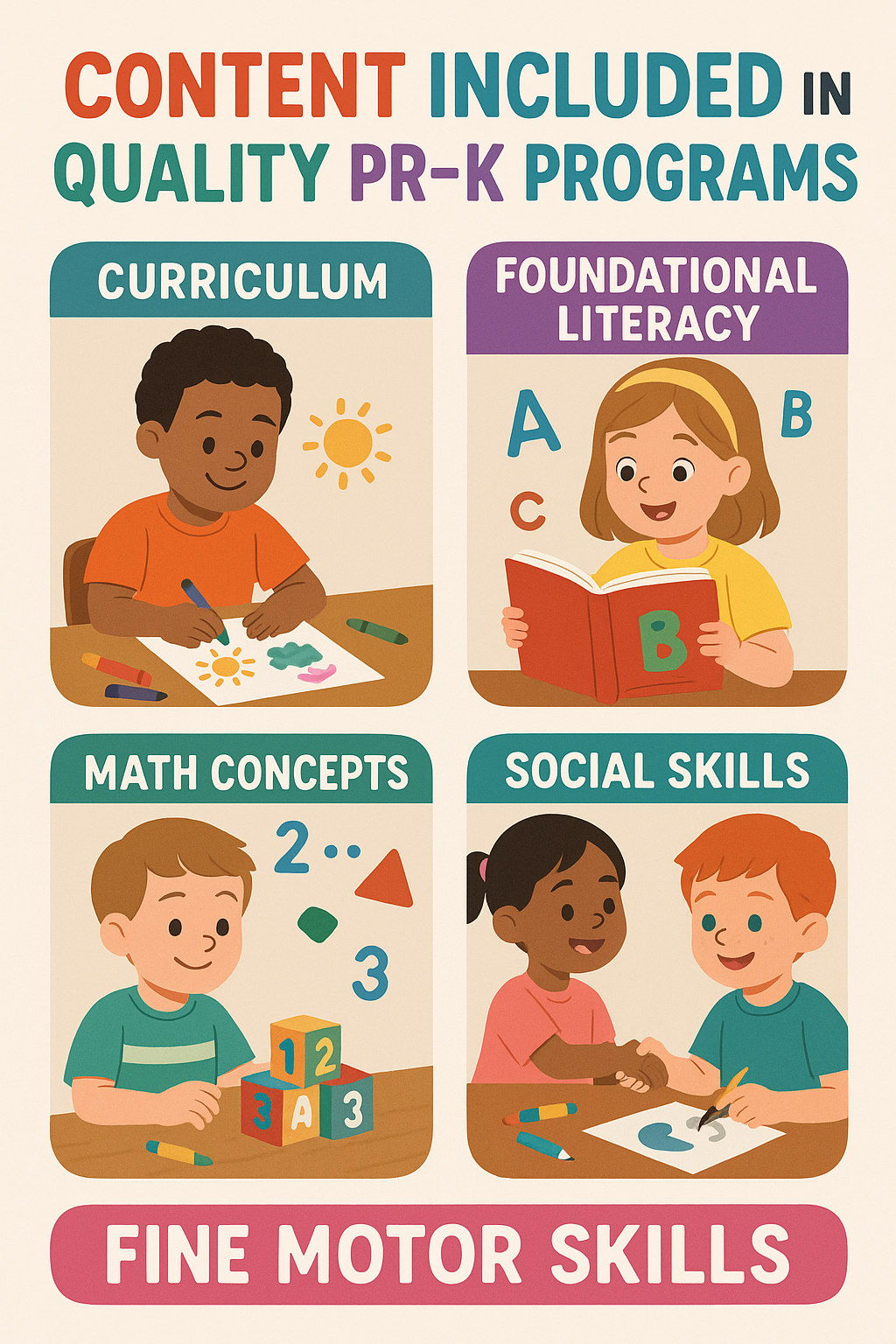
A high-quality pre-kindergarten (pre-K) program lays the foundation for a child’s lifelong learning journey. By blending play-based learning with structured educational experiences, quality pre-K programs help children develop essential academic, social, and emotional skills. Let’s explore the core components typically included in these programs, focusing on curriculum design, foundational literacy, early math concepts, social-emotional development, and fine motor skills.
Curriculum: A Balanced and Developmentally Appropriate Approach
The heart of any quality pre-K program is its curriculum. A strong curriculum is developmentally appropriate, meaning it aligns with young children’s cognitive, emotional, and physical stages. It offers a balance between structured instruction and free play, ensuring children engage in meaningful, hands-on activities.
A quality curriculum includes content across several domains—language and literacy, math, science, social studies, the arts, and physical development. Importantly, it is child-centered, culturally responsive, and inclusive, recognizing that children learn best when their backgrounds, interests, and abilities are respected and incorporated into daily lessons.
Teachers in quality pre-K programs use intentional teaching strategies, observing and responding to each child’s learning needs. They also build in flexibility to follow children’s curiosity, fostering creativity and intrinsic motivation. The goal is to prepare children for kindergarten not just academically, but holistically.
Grow and Learn Preschool and Daycare has adopted the concepts from the Fundations® Curriculum, developed by Wilson Language Training®, which is a structured literacy program that focuses on phonemic awareness, phonics, vocabulary, fluency, and comprehension. This approach is aligned with public school districts in the area, including Chandler Unified School District, that utilize the Fundations® curriculum as part of their Tier 1 and Tier 2 instruction for foundational literacy skills in Kindergarten through grade 3.
Foundational Literacy: Building a Love for Language and Reading
Literacy development is a key focus in pre-K, as early language skills are strong predictors of future academic success. Quality programs expose children to rich oral language, vocabulary building, and early reading and writing experiences.
Activities might include:
- Storytime and read-alouds to develop listening skills and comprehension.
- Alphabet activities to recognize letters and their sounds.
- Name writing and journaling to develop early writing skills.
- Rhyming games and songs to build phonemic awareness.
Teachers model fluent reading, introduce new vocabulary, and ask open-ended questions to spark dialogue and critical thinking. Literacy learning is embedded across the day, whether children are reading books, labeling items in the classroom, or making up stories during pretend play.
Math Concepts: Laying the Groundwork for Numeracy
In a quality pre-K program, early math instruction is playful, hands-on, and connected to real-life experiences. Children begin to develop number sense, which is the understanding of numbers and their relationships, as well as early problem-solving skills.
Key math concepts include:
- Counting and number recognition (e.g., recognizing numbers 1–10 and beyond).
- Sorting and classifying objects by attributes like color, shape, or size.
- Basic patterns and sequencing to understand order and predictability.
- Measurement and comparison, using informal units like blocks or hands.
- Geometry and spatial reasoning, such as identifying and manipulating shapes.
Math activities are often integrated into daily routines—for example, counting snacks at snack time, measuring water during play, or creating patterns with beads.
Social Skills: Building Relationships and Emotional Understanding
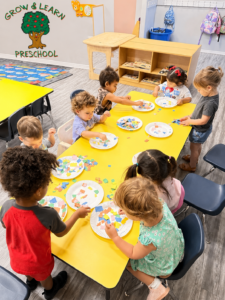
Pre-K is a critical time for children to learn how to interact positively with peers and adults. Quality programs intentionally support the development of social-emotional skills, helping children understand their feelings, cooperate with others, and build empathy.
Social skill development includes:
- Sharing and taking turns during games and group activities.
- Following directions and classroom rules to promote a sense of community.
- Expressing emotions appropriately, such as using words instead of hitting or yelling.
- Solving conflicts peacefully through guided discussions and problem-solving strategies.
- Developing friendships and understanding different perspectives.
Teachers play a vital role by modeling positive behavior, guiding interactions, and providing a safe, nurturing environment. Tools like visual schedules, feeling charts, and social stories can support children in managing emotions and routines.
Fine Motor Skills: Preparing Little Hands for Big Work
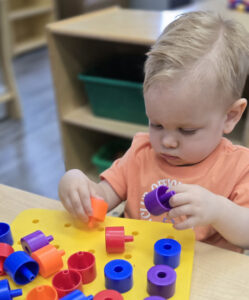
While academic readiness is important, physical development—especially fine motor skills—is also a crucial component of pre-K programs. Fine motor development helps children perform tasks like writing, cutting, buttoning, and manipulating small objects, which are essential for independence and school readiness.
Typical fine motor activities in pre-K include:
- Using crayons, markers, and pencils to draw and write.
- Cutting with scissors to strengthen hand coordination.
- Playing with building blocks, puzzles, and lacing cards to improve dexterity.
- Using tweezers, tongs, or playdough to build grip strength.
These tasks not only prepare children for writing but also build confidence in their ability to complete self-help tasks like zipping coats or opening lunch containers.
Conclusion: A Holistic Start to Lifelong Learning
A quality pre-K program does more than just prepare children for kindergarten—it nurtures the whole child. By addressing academic, social, emotional, and physical domains, pre-K gives children the tools to become curious learners, kind friends, and confident individuals. Parents seeking the best early education experience should look for programs that offer a balanced curriculum, skilled educators, and an environment that celebrates each child’s unique journey.
In today’s educational landscape, investing in quality pre-K is one of the most impactful ways to support a child’s development—and the benefits last far beyond the preschool years. The pre-K program at Grow and Learn Preschool will equip your child with all the tools to be successful as they move to Kindergarten and beyond.